Pages

Showing posts with label philosophy. Show all posts

Friday, September 5, 2014

Meditations: Book Review


Author: Marcus Aurelius Antoninus Augustus

Length: 256 pages

What is It: Meditations is a journal of reflections written by the Roman emperor Marcus Aurelius as an exercise in self expression and self development. Despite his personal intentions (arguably), Meditations has become an important public philosophical text. The emperor divided his writings into twelve books based on different periods of his life. Each book contains reflections ranging from just one sentence to a few short paragraphs.

What's Said: Everything and everyone is connected. Nature is the blueprint for all mankind and should be observed, learned, and followed. Everything that exists is natural and only does what it must. Do not give away your power of self control. Whatever you think of constantly you will become. Happiness depends only on you. Nothing that is said or done can hurt unless you let it. Let that which suffers look unto itself. Our time here on earth is impossibly short. Life decays, reason decays. There is nothing and no one that shall always be remembered. Do not waste time doing unnecessary things. Do not concern yourself with what others do. Life at its essence is constant change. Take the time to penetrate beyond the surface. Death is not to be feared. Nothing can happen to you that is not natural. The universe is not concerned with good and evil. Accept that fate is beyond your control. Practice restraint in the face of difficulty. The two most important virtues are ethics and reason.

What's True: Marcus Aurelius seems to have been a practical man, a rational man, and an honest man. With these journal entries the emperor examines (and reexamines) his own mechanisms for coping with the world and himself. He does so poignantly from many (many) angles on such topics as: the brevity of life, the impermanence of fame, nature as the blue print, fait accompli*, and emotional control. While the emperor is very direct, the grammar and vocabulary of the period (as the case with many classical works) requires sustained focus. Marcus structured his writings around these thoughts - accept the world as it comes; protect your mind as your source of power; be dispassionate in your analysis; distinguish fairness from preference; look for opportunities to practice patience; acknowledge death but respect and revere life. Impressively, he demonstrated these by example, which is why he was one of the most revered emperors in Roman history and why his Meditations is considered a foundation for stoic philosophy**.  

So What: This book is aptly named. Meditations is basically a collection of meditations for careful and methodical self reflection. Marcus Aurelius gives you an extensive list of thought exercises that act as a guide towards your more stoic self. In this sense the repetitive nature of the work actually serves to reinforce its themes. Simply put in the emperor's own words, “…our life is short; we must endeavor to gain the present time with best discretion and justice.” Here the legendary leader shows you how he grappled with the task.

Final Word: Worthwhile but Involved Read

*Life having already been decided (i.e fate), there is no option left but to accept this fact.
**The philosophical view that rationalism and emotional control, in line with nature, are the highest virtues for mankind in a deterministic world.

Wednesday, November 27, 2013

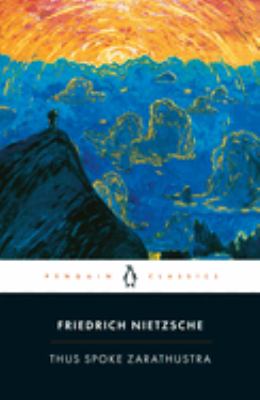
Thus Spoke Zarathustra: Book Review

Thus Spoke Zarathustra

Author: Friedrich Nietzsche (with introduction by R.J. Hollingdale)

Length: 336 pages (plus a 35 page introduction)

What is It: Thus Spoke Zarathustra is a philosophical novel about destruction and power - the destruction of religious tenets and common morality, and the redistribution of that power to the self. Presented in parable form, Friedrich Nietzsche instructs us on how to overcome these societal limitations and become a Superman*. The work, as told through a solitary prophet named Zarathustra, is loosely constructed in four parts which are subdivided into chapters, subtitles, and progressions. 

What's Said: Earth is heaven. God is dead. There is only man. Man is a bridge to the Superman. He must be overcome. Will to power** is what elevates man beyond himself to become a Superman. Your spirit wants and needs freedom (from religion and conventional morality) to create its own will. Fear, cowardice, and laziness created the gods and an afterlife. "Good" and "Evil" were created by and for those with their own will to power agenda. Freedom from this demands creation. The highest virtue is creating virtue. In order to create you must be willing to destroy - but first you must love. Love of life should be your highest hope. Your passions should be your virtues. There is no single truth, only individual truth. Embrace solitude - all great things flow from it and away from crowds. Learn to love one's self and not go roaming. All men are not equal, the best want to rule. If you cannot create and obey your own self, you will be commanded. So accept the burden of greatness, find the inner strength to overcome your restrictions, and create for yourself. Moderation is mediocrity. The only way to live life is to view it as an eternal recurrence. What is failure in the face of the future where so much is still possible?

What's True: Nietzsche has tremendous wit and a sharp tongue (prompting many high laughter and cringe worthy moments). Thus Spoke Zarathustra is a rejection of Nietzsche's religious upbringing and philosophical knowledge. Obvious structural references include The Bible and Plato. Parable form makes this a much lighter read than many other philosophical works. Language and style still take a while to get used to. Nietzsche repeats himself frequently - this could have been much more tightly written. It is clear Nietzsche recognizes and upholds the supreme power of the individual over the state, over leaders, and over the masses. To him poets are superficial, priests live for and promote death, and other philosophers tell people what they want to hear. Thus, the meaning of life - to continually overcome one's self and become greater and greater - is inward. Success at this is joy. The Superman loves life so much and masters it so well that he is willing to live the same one over and over again.  

So What: This is a book for everyone. In its simplest form, Thus Spoke Zarathustra is a motivational masterpiece extolling the virtues of a better you. Nietzsche wants to you become your best self and walks you past all pitfalls and doubts. He wants you to be free to create your own life, make mistakes along the way, laugh when you fail, and enjoy it all the while, because this is the only thing we know we get for sure.

Final Word: Definite Read

*Ladies, I apologize on Nietzsche's behalf for the domineeringly male focused view of this text.
** Will to power is a central theme for Nietzsche and it is many things: the desire for control over your life - the need to create and set its meaning; the pursuit of power and the removal of fear (i.e., lack of power); the desire to assert yourself; your inner qualities; your self as creator and master; your truth.

Thursday, January 24, 2013

A Treatise Concerning the Principles of Human Knowledge: Book Review


Author: George Berkeley (with introduction by Kenneth Winkler)

Length: 87 pages (plus a 36 page introduction)

What is It: An argument against abstractionism*. A philosophical exercise in defense of immaterialism**. An examination of the consequences of success with the aforementioned- on philosophy, science, and atheism. A philosophical basis for the existence of a divine power. Principles is organized in 156 paragraph-like sections, which largely break Berkeley's arguments into digestible blocks.

What's Said: Everything we perceive exists in the mind (ideas and objects). The mind is the only thing of substance. Nothing can exist independently of it. Every thing that is, therefore exists only there. Abstraction of ideas is not directly perceivable and is therefore impossible. This foundation of materialism is the cause of much confusion in philosophy, science and religion. Things cannot cause ideas or vice versa. Cause and effect as we know it therefore does not exist. Things and ideas can only be caused by minds because minds are the only substances capable of defining an intentional purpose. As imagination exists in ours, the real world of sense exists in that of a superior mind. God therefore exists.

What's True: It takes a while to understand the ebb and flow of Berkeley's writing style. This edition is well organized: useful companion notes, reference notes, timelines and a glossary. Berkeley is obsessed with language/semantics and its connection to thoughts and things. His arch enemy is apparently John Locke, whom he singles out several times. Berkeley is a very witty and pithy debater, as a result this book is sometimes very entertaining! Berkeley defends his argument more than he advances it. It is not obvious at first, but he has an agenda - convincing the reader to logically accept the existence of God. Principles is a somewhat challenging read, thus it is not necessarily a page turner. Despite that, when it comes to philosophical texts, this is a very accessible piece of work.

So What: On occasion it is worth reading a book that challenges the way you think. This is a relatively short (albeit dense) treatise that does just that. Principles challenges fundamental views of the world, which means that it pushes you to think: differently, empathetically, and critically. This also makes Principles an exercise in patience and persistence, but these are all of the things that make reading philosophy rewarding.

Final Word: Worthwhile Read


Concrete Examples from Winkler in the Berkeley School of Thought:
* Abstractionism: The abstract idea of "man" [for example] represents every man without representing any man in particular. It is an indifferent representation of all men. [Berkeley's view is that this] "man" must be the product of some kind of mental manufacturing because this would be an image (a kind of object) of a very unusual kind - try to imagine a "man" without all the ideas of particular men derived from experience directly. [It is impossible].
** Immaterialism: If a tree falls in the forest when there is no one around to hear it, does it make a sound? [According to Berkeley], if there is really no one around, then not only is there no sound, but there is no tree, and no forest. [Berkeley believes] there [is] no material substance. [That which we think is], is only a collection of ideas which depends for its existence on the mind.