Pages

Showing posts with label snapshot. Show all posts

Friday, September 5, 2014

Meditations: Book Review


Author: Marcus Aurelius Antoninus Augustus

Length: 256 pages

What is It: Meditations is a journal of reflections written by the Roman emperor Marcus Aurelius as an exercise in self expression and self development. Despite his personal intentions (arguably), Meditations has become an important public philosophical text. The emperor divided his writings into twelve books based on different periods of his life. Each book contains reflections ranging from just one sentence to a few short paragraphs.

What's Said: Everything and everyone is connected. Nature is the blueprint for all mankind and should be observed, learned, and followed. Everything that exists is natural and only does what it must. Do not give away your power of self control. Whatever you think of constantly you will become. Happiness depends only on you. Nothing that is said or done can hurt unless you let it. Let that which suffers look unto itself. Our time here on earth is impossibly short. Life decays, reason decays. There is nothing and no one that shall always be remembered. Do not waste time doing unnecessary things. Do not concern yourself with what others do. Life at its essence is constant change. Take the time to penetrate beyond the surface. Death is not to be feared. Nothing can happen to you that is not natural. The universe is not concerned with good and evil. Accept that fate is beyond your control. Practice restraint in the face of difficulty. The two most important virtues are ethics and reason.

What's True: Marcus Aurelius seems to have been a practical man, a rational man, and an honest man. With these journal entries the emperor examines (and reexamines) his own mechanisms for coping with the world and himself. He does so poignantly from many (many) angles on such topics as: the brevity of life, the impermanence of fame, nature as the blue print, fait accompli*, and emotional control. While the emperor is very direct, the grammar and vocabulary of the period (as the case with many classical works) requires sustained focus. Marcus structured his writings around these thoughts - accept the world as it comes; protect your mind as your source of power; be dispassionate in your analysis; distinguish fairness from preference; look for opportunities to practice patience; acknowledge death but respect and revere life. Impressively, he demonstrated these by example, which is why he was one of the most revered emperors in Roman history and why his Meditations is considered a foundation for stoic philosophy**.  

So What: This book is aptly named. Meditations is basically a collection of meditations for careful and methodical self reflection. Marcus Aurelius gives you an extensive list of thought exercises that act as a guide towards your more stoic self. In this sense the repetitive nature of the work actually serves to reinforce its themes. Simply put in the emperor's own words, “…our life is short; we must endeavor to gain the present time with best discretion and justice.” Here the legendary leader shows you how he grappled with the task.

Final Word: Worthwhile but Involved Read

*Life having already been decided (i.e fate), there is no option left but to accept this fact.
**The philosophical view that rationalism and emotional control, in line with nature, are the highest virtues for mankind in a deterministic world.


Wednesday, November 27, 2013

Thus Spoke Zarathustra: Book Review

Thus Spoke Zarathustra

Author: Friedrich Nietzsche (with introduction by R.J. Hollingdale)

Length: 336 pages (plus a 35 page introduction)

What is It: Thus Spoke Zarathustra is a philosophical novel about destruction and power - the destruction of religious tenets and common morality, and the redistribution of that power to the self. Presented in parable form, Friedrich Nietzsche instructs us on how to overcome these societal limitations and become a Superman*. The work, as told through a solitary prophet named Zarathustra, is loosely constructed in four parts which are subdivided into chapters, subtitles, and progressions. 

What's Said: Earth is heaven. God is dead. There is only man. Man is a bridge to the Superman. He must be overcome. Will to power** is what elevates man beyond himself to become a Superman. Your spirit wants and needs freedom (from religion and conventional morality) to create its own will. Fear, cowardice, and laziness created the gods and an afterlife. "Good" and "Evil" were created by and for those with their own will to power agenda. Freedom from this demands creation. The highest virtue is creating virtue. In order to create you must be willing to destroy - but first you must love. Love of life should be your highest hope. Your passions should be your virtues. There is no single truth, only individual truth. Embrace solitude - all great things flow from it and away from crowds. Learn to love one's self and not go roaming. All men are not equal, the best want to rule. If you cannot create and obey your own self, you will be commanded. So accept the burden of greatness, find the inner strength to overcome your restrictions, and create for yourself. Moderation is mediocrity. The only way to live life is to view it as an eternal recurrence. What is failure in the face of the future where so much is still possible?

What's True: Nietzsche has tremendous wit and a sharp tongue (prompting many high laughter and cringe worthy moments). Thus Spoke Zarathustra is a rejection of Nietzsche's religious upbringing and philosophical knowledge. Obvious structural references include The Bible and Plato. Parable form makes this a much lighter read than many other philosophical works. Language and style still take a while to get used to. Nietzsche repeats himself frequently - this could have been much more tightly written. It is clear Nietzsche recognizes and upholds the supreme power of the individual over the state, over leaders, and over the masses. To him poets are superficial, priests live for and promote death, and other philosophers tell people what they want to hear. Thus, the meaning of life - to continually overcome one's self and become greater and greater - is inward. Success at this is joy. The Superman loves life so much and masters it so well that he is willing to live the same one over and over again.  

So What: This is a book for everyone. In its simplest form, Thus Spoke Zarathustra is a motivational masterpiece extolling the virtues of a better you. Nietzsche wants to you become your best self and walks you past all pitfalls and doubts. He wants you to be free to create your own life, make mistakes along the way, laugh when you fail, and enjoy it all the while, because this is the only thing we know we get for sure.

Final Word: Definite Read

*Ladies, I apologize on Nietzsche's behalf for the domineeringly male focused view of this text.
** Will to power is a central theme for Nietzsche and it is many things: the desire for control over your life - the need to create and set its meaning; the pursuit of power and the removal of fear (i.e., lack of power); the desire to assert yourself; your inner qualities; your self as creator and master; your truth.

Sunday, June 30, 2013

Guns, Germs, And Steel: Book Review


Author: Jared Diamond 

Length: (425 pages, plus a 15 page afterword)

What is It: Guns, Germs, And Steel is a theory on the evolution of society - not in terms of biological or evolutionary differences but in terms of geographical and sociological differences. GGS attempts to answer the question: "Why did history unfold differently on different continents?" The author goes beyond proximate forces like trade, technology, and societal organization to uncover what he defines as "ultimate causes".  Diamond does this by exploring a broader view of world history (beyond Europe, The Middle East, and North Africa), by studying smaller time scales (hundreds to thousands of years instead of the last 13,000) and by analyzing natural experiments (history of the Polynesian migration) in order to better identify, isolate, and understand these ultimate causes on a global scale.

What's Said: Geographical differences in the local availability of wild plants and animals were key driving forces in societal development. The orientation of the continental axes (east to west like in Euroasia is better than north to south like in The Americas & Africa) created stark differences in climate, biodiversity, and idea diffusion. Human migration led to the mass extinction of domesticable animals on most other continents besides Euroasia. The caloric efficiency of food production was the source of the gradual shift from hunter-gathering to farming. Farming affects population density by requiring settlement, necessitating storage, providing seasonal downtime, and supporting higher birthrates. Excess food production contributed to the permissibility of specialization, innovation, and kleptocracy. Bureaucratic organization becomes necessary because of limits to communal decision making, inefficiencies in pairwise economic exchange, increasingly difficult conflict resolution, and resource constraints. Writing was created to record food production and to protect systemic administration - not to support public expression. Religion and patriotism provided the shared ideology and motivation for citizens to sacrifice their lives and self interests on behalf statehoods, which was a radical break from the human social contract. Euroasia's conquest of much of the world (and not the other way around) was due to the separate trajectory of all these causes and evolutions.

What's True: Euroasia is the world's largest landmass and one of its most ecologically diverse landscapes. Localities distributed across latitudes are very similar in terms of seasons, time, temperature, habitats, and diseases compared to longitudinal axes. The efficiency of farming is 10-100 times that of hunter-gathering. Food production (wheat, pea, olives) arose the earliest in Southwest Asia (Near East/Fertile Crescent), around 8500 BC. Only a very small minority of wild plants and animals have been domesticated for food. A dozen plant species account for over 80% of the modern world's crops, and less than 15% of wild animals are domesticable (18% Euroasia, 4% in America, 0% in Africa). Domesticating animals depends on their diet, growth rate, disposition, social structure, and captive reproduction. Domesticating plants depends on fruit size, dispersal mechanism, taste, fleshiness, oiliness, yield, fiber length, and reproduction. Eurasian culture likely yielded more calories and organization per person on average than Native American culture. Large scale deadly diseases (smallpox, measles, flu) evolved through the mutations of germs during animal domestication and is almost exclusive to large dense populations of social animals like humans and livestock. More Native Americans died from Eurasian germs than European guns and swords (over 95%). Archeological evidence suggests that North America was occupied by 20M local natives upon Columbus' arrival rather the 1M often cited. 

So What: 
The writing in Guns, Germs, And Steel is cumbersome at times, but given the breadth and depth of the material and the objective this can be forgiven. GGS paints a new picture of global civilization that is completely independent of the need for one race to be superior than another other - an astounding theoretical feat. This is not just an academic exercise, however. GGS is instead, a practical and political guide to the driving forces behind many of the historical legacies that still shape our geopolitical landscape today. The approach that Diamond takes is methodical, and I agree that more work should be done to adapt the methods of hard sciences into the study of history.

Final Word: Very Enlightening Read

Thursday, April 4, 2013

On Intelligence: Book Review


Author: Jeff Hawkins (with Sandra Blakeslee)

Length: 235 pages (plus an 8 page appendix of predictions)

What is It: A comprehensive theory on the inner workings of the brain (memory, intelligence and creativity), including its relevance to building intelligent machines. Hawkins starts with a brief history of artificial intelligence and neural networks, but openly challenges them as design foundations. He then presents his memory-prediction theory as a more comprehensive and accurate representation. He ends On Intelligence with a sketch of the future based on his model and a series of testable predictions.

What's Said: Theories of the brain should be based on i) elapsed time, ii) feedback loops and iii) complete architecture. The brain is not a computer; it is a memory system. It distills incoming sequences of patterns (eg: letters of a word in a speech) into invariant forms [snapshots of constantly changing details], passes this delayed pattern up its hierarchical structure (eg: from letters to words in this analogy), repeats that process at each of its six levels (eg: words to phrases, phrases to sentences...), and links all those sequences together through auto association for retrieval later (eg: remembering that speech by recalling just a word/phrase/sentence in it). Detailed predictions using this system are the essence of intelligence. The brain predicts by combining its knowledge of invariant forms from higher brain levels with current details from the senses, and lower levels. This algorithm is the main function of the brain and is exactly the same everywhere (i.e. the primary senses are fundamentally no different from each other). Correct predictions result in understanding, incorrect predictions result in confusion.

What's True: There are 10 times as many feedback as input connections in the brain. Human intellectual superiority is explained by size of the neocortex and its hierarchical levels of sophistication (ability to handle more abstraction, and longer temporal patterns than animals). The Turing Test is misguided because intelligence cannot be accurately measured by external behavior (computational output), it is an inner brain function (understanding does not require action). The memory-prediction framework distinctly separates intelligence from human form and emotions (which negates "rise of the machines" scenarios). Intelligence systems are customized machines that can excel where human intelligence is disinterested or human senses are inadequate. Hawkins is clear and transparent in OI. He not only lays out his theory, he addresses rebuttals, and willingly points out potential flaws in the model. Even if his theory is correct however, capacity (the brain has an estimated 8 trillion bytes of memory) and connectivity (one brain cell connects to an estimated 10 thousand other brain cells) will still be challenges. 

So What: Hawkins' theory has significant implications for the development of intelligent machines. It means that design thinking centered on faster computing, larger memory, and behavior driven output is absolutely misdirected. It means newer innovations like big data (inputs and discovery) and machine learning (pattern recognition and prediction) should be not be explored separately; they should be studied as components of a single intelligent system. For individuals, On Intelligence provides new insights on the way humans think, why we think like we do, and how thought is connected to itself and behavior.


Final Word: Very Enlightening Read

Tuesday, March 12, 2013

Eat, Drink, and Be Healthy: Book Review


Author: Walter Willett (with Patrick Skerrett and co-developed with the Harvard School of Public Health)

Length: 250 pages (plus a 68 pages of recipes)

What is It: A practical guide through the facts and statistics on nutrition and their link to health and disease (heart attack, diabetes, high blood pressure, cancer). EDBH educates by conveniently repeating important details and definitions, which helps deprogram common misconceptions and reinforce the absorption of new health information. The book covers these topics: weight control, diets, fats, carbohydrates, protein, vitamins, calcium, protein, fruits, vegetables and multivitamins.

What's Said: 
WEIGHT
Genes play a role, but only partly. Weight change equals calories in minus calories out. A calorie is a calorie, no matter how you get it. There is a positive correlation between BMI and the death rate. When fad diets "work" it is mainly because they make you focus on what and how much you eat. Weight gain is not inevitable, many cultures maintain their adulthood weight. Exercise! Activity is most beneficial when it speeds up your heart rate and breathing. 
FOOD
Not all fat is bad for you (eg: most liquid oils, omega fats), but trans fat absolutely is, and saturated fat should be limited. Eating good fat (mono- and poly- unsaturated fats) improves your cholesterol (by lowering LDL). Not all simple or complex carbohydrates are bad (eg: intact whole wheat grains). However, highly refined carbohydrates (white: flour, rice) create volatile glucose-insulin levels that can generate a feeling of unsatisfied hunger (just like sugar). You need calcium, not milk and dairy products. Vitamin D and K are just as important to building healthy bones. Vegetable protein is better in terms of saturated fat and fiber, though meat protein is more complete (fix by mixing beans, nuts, grains). Organic fruits and vegetables are not materially better than regular or frozen ones (they taste and are better for the environment though). Eat fruits and vegetables in a variety of colors for optimal benefit. Fruits and vegetables are better fresh than cooked (destroys nutrients - except in tomatoes). 
DRINKS
Coffee in moderation is good for you (antidepressant, lowers risk of kidney/gall- stones, diabetes). Alcohol is good in moderation (increases HDL, reduces clotting). Soda is an awful beverage with no nutritionally redeeming value. Drink enough fluids so that your urine is consistently clear or pale yellow. 
LABELS
Check nutritional tables against the list of ingredients provided. Ingredients are listed in order of descending weight/importance. Wheat flour is not the same as whole-wheat flour (much better). Trans fat is also known as vegetable shortening and partially (or just) hydrogenated oil. Check total fat against sum of listed fats (difference is trans fat).
OTHER
Store brand, RDA-level, USP approved multivitamins are perfectly fine.

What's True: Nutrition is a complex, evolving science; do not be surprised by the lack of clear, definite answers. The following have solid foundations, however: Maintaining a healthy weight is the most important thing you can do for your health. Exercise and activeness are the best things that you can do for weight control. Based on nutritional factors, most diets do not actually work. The next best health move is to eat better fats and carbohydrates. Substituting your diet with more fruits and vegetables has tremendous health benefits. Taking a multivitamin in addition to the above is a good back up option. 

So What: Food companies have built billion dollar businesses exploiting our tastes/habits (ex: got milk ads, sugar additions) and influencing agricultural policies (ex: the USDA food pyramid, corn consumption). There are key components you need to understand and specific knowledge you can act upon to protect your health. Youth and genes are vulnerable defenses. They are not enough. You need leverage. This book is that leverage, and thankfully its purpose is not just to inform or entertain; it has a higher standard - to educate. It challenges you look at your food differently and, as a result, hopefully eat healthier.

Final Word: Must Read


My Cheat Sheet*:
- replace some of your packaged snacks and desserts with fruits and nuts
- stock less junk food (if it's not around you're less likely to eat it!)
- don't drink soda regularly (it's just sugar and unnecessary calories)
- dilute juices with flat/sparkling water (lasts longer and saves calories)
- practice eating until the point you are satisfied, but before you are full
- eat smaller when you eat out (share/save the rest - it's multi-servings!)
- instead of butter/margerine, use oils or avocado for cooking or spreading
- drive less and walk more, park farther away, take the stairs
- eat meals with a large variety, instead of a large quantity, of food
- specific foods to substitute with more:
    spinach (so many nutrients: vitamin A, D, K, folic acid, potassium)
    beans - black, kidney, baked, lentils (protein, potassium, folic acid)
    oils - olive, safflower, sunflower, canola (lowers LDL and raises HDL)
    grainy and dark breads (low glycemic load, good carbs)
    wheat thins, triscuits (good replacement for crackers, chips)
    cereals: wheat chex, wheaties, kashi 1st; bran flakes, wheat germ 2nd
    chicken and tuna (higher % protein and less calories than beef)
    nuts - hazel, almonds, pine, walnuts, pecans (in order of UnS/S fat)
- general foods to consume less of or use in moderation:
    white potatoes, white rice (not so great, refined carbohydrates)
    dairy (saturated fat, hormones, lactose issues, excess linked to cancer)
    soy (good protein substitute in moderation, but still studying +/-s)

*DISCLOSURE: I am not a doctor, nor do I even pretend to be one on TV so [1] you can always read EDBH yourself and draw insights directly (it's worth it), and [2] always consult your physician before making major changes to your diet.

Thursday, January 24, 2013

A Treatise Concerning the Principles of Human Knowledge: Book Review


Author: George Berkeley (with introduction by Kenneth Winkler)

Length: 87 pages (plus a 36 page introduction)

What is It: An argument against abstractionism*. A philosophical exercise in defense of immaterialism**. An examination of the consequences of success with the aforementioned- on philosophy, science, and atheism. A philosophical basis for the existence of a divine power. Principles is organized in 156 paragraph-like sections, which largely break Berkeley's arguments into digestible blocks.

What's Said: Everything we perceive exists in the mind (ideas and objects). The mind is the only thing of substance. Nothing can exist independently of it. Every thing that is, therefore exists only there. Abstraction of ideas is not directly perceivable and is therefore impossible. This foundation of materialism is the cause of much confusion in philosophy, science and religion. Things cannot cause ideas or vice versa. Cause and effect as we know it therefore does not exist. Things and ideas can only be caused by minds because minds are the only substances capable of defining an intentional purpose. As imagination exists in ours, the real world of sense exists in that of a superior mind. God therefore exists.

What's True: It takes a while to understand the ebb and flow of Berkeley's writing style. This edition is well organized: useful companion notes, reference notes, timelines and a glossary. Berkeley is obsessed with language/semantics and its connection to thoughts and things. His arch enemy is apparently John Locke, whom he singles out several times. Berkeley is a very witty and pithy debater, as a result this book is sometimes very entertaining! Berkeley defends his argument more than he advances it. It is not obvious at first, but he has an agenda - convincing the reader to logically accept the existence of God. Principles is a somewhat challenging read, thus it is not necessarily a page turner. Despite that, when it comes to philosophical texts, this is a very accessible piece of work.

So What: On occasion it is worth reading a book that challenges the way you think. This is a relatively short (albeit dense) treatise that does just that. Principles challenges fundamental views of the world, which means that it pushes you to think: differently, empathetically, and critically. This also makes Principles an exercise in patience and persistence, but these are all of the things that make reading philosophy rewarding.

Final Word: Worthwhile Read


Concrete Examples from Winkler in the Berkeley School of Thought:
* Abstractionism: The abstract idea of "man" [for example] represents every man without representing any man in particular. It is an indifferent representation of all men. [Berkeley's view is that this] "man" must be the product of some kind of mental manufacturing because this would be an image (a kind of object) of a very unusual kind - try to imagine a "man" without all the ideas of particular men derived from experience directly. [It is impossible].
** Immaterialism: If a tree falls in the forest when there is no one around to hear it, does it make a sound? [According to Berkeley], if there is really no one around, then not only is there no sound, but there is no tree, and no forest. [Berkeley believes] there [is] no material substance. [That which we think is], is only a collection of ideas which depends for its existence on the mind.

Friday, December 28, 2012

Founders At Work: Book Review


Author: Jessica Livingston

Length: 453 pages

What is It: An inside look at the creation of some of technology's most popular and most innovative startups, as told by the founders themselves through interviews. 

What's Said: Founders go through the evolution of their startups from conception to execution and often through exit. Difficulties, mistakes and setbacks are disclosed. Turning points and surprises of the businesses and their skills are discussed. Founders share times when they or their product were misjudged/misunderstood. The triumphs and tribulations of bootstrapping and funding are laid bare. Includes direct advice for potential entrepreneurs. Interviews are grouped by company and loosely ordered by relevance to previous interviews or technologies.

What's True: Founders tend to be product and user driven. Absolute persistence is a necessity. Adaptability and flexibility are key because nothing goes according to plan. Constraints on resources like time and money often spur creativity. Trust and culture are incredibly important between (1) startup founders, (1) + (2) first hires, and (1) + (3) active investors. Startups are very often built to solve personal problems or as vehicles for significant impact. Founders deliberately nurture incredible ideas, but they also simply stumble into them. Entrepreneurs create value from depth of experience as well as from naivety. Timing and luck are notable x-factors in the success or failure of a business. Good advice is not necessarily correlated with spectacular success, i.e. do not discount the startups/entrepreneurs you have not heard of.

So What: Each venture has its own solution that must be optimized for, but Founders at Work outlines very timely variables in the startup equation. Beyond the practical, FW can serve as a good motivational guide for frustrated, impatient or weary entrepreneurs. It humanizes these heroes who have often attained mythical qualities from afar (with some exceptions). By the end, Founders seems to ask the question, "Now that you know these things, what are you going to do about it?"

Final Word: Definite Read

Wednesday, October 31, 2012

Master of The Senate: Book Review


Author: Robert Caro

Length: 1,049 pages

What is It: A thorough look at the inner machinations and accomplishments of Lyndon Johnson's U.S. Senate career as orchestrated by the pragmatic politician himself.

What's Said: The rich history of the Senate, the intricacies of its internal dynamics and rules, and the relationship of the chamber to Congress and the President are illuminated here. That is the backdrop to an examination of Lyndon Johnson's political life - a tale of motivations, ambitions, fears, failures, dealings, compassion, ruthlessness, affairs, manipulations, genius, gruffness, practicality and familial influence. All of which are defined and give full context to or for his actions. MTS is largely organized around LBJ's development and relationship with political power with a secondary adherence to the linear timeline of his life in the Senate.

What's True: The Senate was well designed by the forefathers to withstand the incredible power of the will/whims of the people. It is a body vulnerable mostly unto itself. The struggle of the Civil War lived on in the ideology of the "southern senators" who exacted their revenge upon the union (but really the nation) by their actions and inactions. Effectiveness in bipartisan politics requires an element of practicality - ideology alone is not enough. LBJ's genius lied in his adept attention not only to legislative detail but to the legislator himself, multiplied by an uncanny ability to read and act upon those details. MTS is a full measure the senator, not just as eventual champion of civil rights, but also as a prominent detractor. Like most historic figures who get distilled, LBJ's true being is far more complex in reality. This is a thorough and balanced account of that, and a painstaking deconstruction of how to acquire, maintain and exact power.

So What: History's influence in our affairs comes from the exercise of looking at what has transpired and transposing that experience onto our present and future. The open question is always: Would we want this to be repeated? The trade off between idealism and practicality is real in politics and should be answered carefully by those who practice and we who elect. Lastly - don't be quickly discouraged - this book is a page turner, rich in plot, character development and scenery. It builds and delivers like a literary masterpiece. And if you have any interest in history, power, politics, or the man, you will undoubtedly appreciate this.

Final Word: Definite Read

Wednesday, October 3, 2012

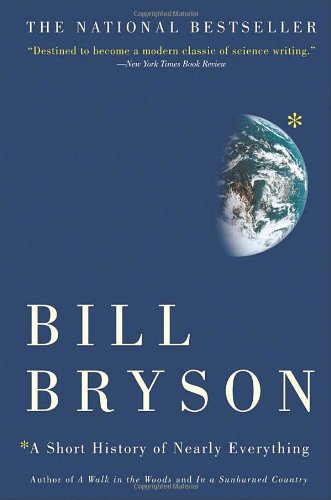
A Short History of Nearly Everything: Book Review


Author: Bill Bryson

Length: 478 pages

What is It: A survey of science on earth including the cross-histories of the people who helped develop it.

What's Said: Starts from the universe at large, switches to the development and progression of the disciplines, drills down into an examination of the earth specifically and then discusses the advancement of life on the planet, culminating with the human race. Topics include - the solar system, paleontology, relativity, geology, chemistry, atoms, cells, quarks, the big bang, the troposphere, tectonics, oceans, bacteria, DNA, evolution.

What's True:  It is possible to be coherent on a wide range of scientific topics despite their individual depth and breadth. Scientific accuracy can be maintained without losing integrity. There is an incredible amount that we have discovered, but science is always building and changing. Obsession, madness, luck, and brilliance have shown us the way. Progress is championed by both specialists and laymen. Drama unfolds within science just as it does anywhere else people are involved.

So What: ASH's success is that it takes scientific history and facts and makes them accessible in an interesting and relevant way. It reminds the reader of what we often take for granted: the fickleness and complexity of life on earth, and how lucky we are to be alive and able to appreciate it. Bryson levels the scientific world to place where everyone can look at it with informed wonder.

Final Word: Must Read