Pages

Showing posts with label science. Show all posts

Sunday, June 30, 2013

Guns, Germs, And Steel: Book Review


Author: Jared Diamond 

Length: (425 pages, plus a 15 page afterword)

What is It: Guns, Germs, And Steel is a theory on the evolution of society - not in terms of biological or evolutionary differences but in terms of geographical and sociological differences. GGS attempts to answer the question: "Why did history unfold differently on different continents?" The author goes beyond proximate forces like trade, technology, and societal organization to uncover what he defines as "ultimate causes".  Diamond does this by exploring a broader view of world history (beyond Europe, The Middle East, and North Africa), by studying smaller time scales (hundreds to thousands of years instead of the last 13,000) and by analyzing natural experiments (history of the Polynesian migration) in order to better identify, isolate, and understand these ultimate causes on a global scale.

What's Said: Geographical differences in the local availability of wild plants and animals were key driving forces in societal development. The orientation of the continental axes (east to west like in Euroasia is better than north to south like in The Americas & Africa) created stark differences in climate, biodiversity, and idea diffusion. Human migration led to the mass extinction of domesticable animals on most other continents besides Euroasia. The caloric efficiency of food production was the source of the gradual shift from hunter-gathering to farming. Farming affects population density by requiring settlement, necessitating storage, providing seasonal downtime, and supporting higher birthrates. Excess food production contributed to the permissibility of specialization, innovation, and kleptocracy. Bureaucratic organization becomes necessary because of limits to communal decision making, inefficiencies in pairwise economic exchange, increasingly difficult conflict resolution, and resource constraints. Writing was created to record food production and to protect systemic administration - not to support public expression. Religion and patriotism provided the shared ideology and motivation for citizens to sacrifice their lives and self interests on behalf statehoods, which was a radical break from the human social contract. Euroasia's conquest of much of the world (and not the other way around) was due to the separate trajectory of all these causes and evolutions.

What's True: Euroasia is the world's largest landmass and one of its most ecologically diverse landscapes. Localities distributed across latitudes are very similar in terms of seasons, time, temperature, habitats, and diseases compared to longitudinal axes. The efficiency of farming is 10-100 times that of hunter-gathering. Food production (wheat, pea, olives) arose the earliest in Southwest Asia (Near East/Fertile Crescent), around 8500 BC. Only a very small minority of wild plants and animals have been domesticated for food. A dozen plant species account for over 80% of the modern world's crops, and less than 15% of wild animals are domesticable (18% Euroasia, 4% in America, 0% in Africa). Domesticating animals depends on their diet, growth rate, disposition, social structure, and captive reproduction. Domesticating plants depends on fruit size, dispersal mechanism, taste, fleshiness, oiliness, yield, fiber length, and reproduction. Eurasian culture likely yielded more calories and organization per person on average than Native American culture. Large scale deadly diseases (smallpox, measles, flu) evolved through the mutations of germs during animal domestication and is almost exclusive to large dense populations of social animals like humans and livestock. More Native Americans died from Eurasian germs than European guns and swords (over 95%). Archeological evidence suggests that North America was occupied by 20M local natives upon Columbus' arrival rather the 1M often cited. 

So What: 
The writing in Guns, Germs, And Steel is cumbersome at times, but given the breadth and depth of the material and the objective this can be forgiven. GGS paints a new picture of global civilization that is completely independent of the need for one race to be superior than another other - an astounding theoretical feat. This is not just an academic exercise, however. GGS is instead, a practical and political guide to the driving forces behind many of the historical legacies that still shape our geopolitical landscape today. The approach that Diamond takes is methodical, and I agree that more work should be done to adapt the methods of hard sciences into the study of history.

Final Word: Very Enlightening Read

Thursday, April 4, 2013

On Intelligence: Book Review


Author: Jeff Hawkins (with Sandra Blakeslee)

Length: 235 pages (plus an 8 page appendix of predictions)

What is It: A comprehensive theory on the inner workings of the brain (memory, intelligence and creativity), including its relevance to building intelligent machines. Hawkins starts with a brief history of artificial intelligence and neural networks, but openly challenges them as design foundations. He then presents his memory-prediction theory as a more comprehensive and accurate representation. He ends On Intelligence with a sketch of the future based on his model and a series of testable predictions.

What's Said: Theories of the brain should be based on i) elapsed time, ii) feedback loops and iii) complete architecture. The brain is not a computer; it is a memory system. It distills incoming sequences of patterns (eg: letters of a word in a speech) into invariant forms [snapshots of constantly changing details], passes this delayed pattern up its hierarchical structure (eg: from letters to words in this analogy), repeats that process at each of its six levels (eg: words to phrases, phrases to sentences...), and links all those sequences together through auto association for retrieval later (eg: remembering that speech by recalling just a word/phrase/sentence in it). Detailed predictions using this system are the essence of intelligence. The brain predicts by combining its knowledge of invariant forms from higher brain levels with current details from the senses, and lower levels. This algorithm is the main function of the brain and is exactly the same everywhere (i.e. the primary senses are fundamentally no different from each other). Correct predictions result in understanding, incorrect predictions result in confusion.

What's True: There are 10 times as many feedback as input connections in the brain. Human intellectual superiority is explained by size of the neocortex and its hierarchical levels of sophistication (ability to handle more abstraction, and longer temporal patterns than animals). The Turing Test is misguided because intelligence cannot be accurately measured by external behavior (computational output), it is an inner brain function (understanding does not require action). The memory-prediction framework distinctly separates intelligence from human form and emotions (which negates "rise of the machines" scenarios). Intelligence systems are customized machines that can excel where human intelligence is disinterested or human senses are inadequate. Hawkins is clear and transparent in OI. He not only lays out his theory, he addresses rebuttals, and willingly points out potential flaws in the model. Even if his theory is correct however, capacity (the brain has an estimated 8 trillion bytes of memory) and connectivity (one brain cell connects to an estimated 10 thousand other brain cells) will still be challenges. 

So What: Hawkins' theory has significant implications for the development of intelligent machines. It means that design thinking centered on faster computing, larger memory, and behavior driven output is absolutely misdirected. It means newer innovations like big data (inputs and discovery) and machine learning (pattern recognition and prediction) should be not be explored separately; they should be studied as components of a single intelligent system. For individuals, On Intelligence provides new insights on the way humans think, why we think like we do, and how thought is connected to itself and behavior.


Final Word: Very Enlightening Read

Wednesday, October 3, 2012

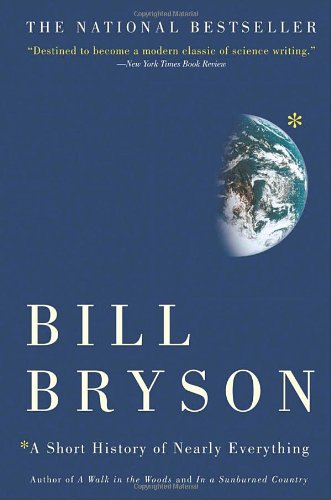
A Short History of Nearly Everything: Book Review


Author: Bill Bryson

Length: 478 pages

What is It: A survey of science on earth including the cross-histories of the people who helped develop it.

What's Said: Starts from the universe at large, switches to the development and progression of the disciplines, drills down into an examination of the earth specifically and then discusses the advancement of life on the planet, culminating with the human race. Topics include - the solar system, paleontology, relativity, geology, chemistry, atoms, cells, quarks, the big bang, the troposphere, tectonics, oceans, bacteria, DNA, evolution.

What's True:  It is possible to be coherent on a wide range of scientific topics despite their individual depth and breadth. Scientific accuracy can be maintained without losing integrity. There is an incredible amount that we have discovered, but science is always building and changing. Obsession, madness, luck, and brilliance have shown us the way. Progress is championed by both specialists and laymen. Drama unfolds within science just as it does anywhere else people are involved.

So What: ASH's success is that it takes scientific history and facts and makes them accessible in an interesting and relevant way. It reminds the reader of what we often take for granted: the fickleness and complexity of life on earth, and how lucky we are to be alive and able to appreciate it. Bryson levels the scientific world to place where everyone can look at it with informed wonder.

Final Word: Must Read